> ## Documentation Index
> Fetch the complete documentation index at: https://graphite-58cc94ce.mintlify.site/docs/llms.txt
> Use this file to discover all available pages before exploring further.
# Introduction To Trunk Based Development
> Learn more about trunk-based development's benefits, best practices, and comparison with Gitflow.
## What is trunk-based development?
Trunk-based development is a practice in which all developers work on a shared branch, called the `trunk` or `mainline` using a version control system of their choice. Instead of creating long-lived feature branches, developers make changes directly to the `main` branch, which is continuously integrated and tested.
## Continuous integration
Trunk-based development is a prerequisite for continuous integration (CI). Each time changes are pushed to the `trunk` branch (which often happens several times a day), a suite of automated tests run before and after the merge to determine whether or not the change introduces regressions.
**Every change to `trunk` triggers a build and a series of automated tests**. A change that breaks your `trunk` branch must be fixed immediately before making any other changes—this may sound time-consuming at first, but since tests are run at each step of the development process, bugs and regressions are encountered far less frequently in a team that practices CI.
## Gitflow vs. trunk-based development
Gitflow is a branching model that creates multiple long-lived branches for different stages of the development process (for example, feature branch, develop branch, release branch, and master branch). Different developers use different techniques to merge/commit between these branches, adding increased complexity to the system.
Additionally, Gitflow developers work on large, long-lived feature branches for collaboration. These feature branches are often maintained for days or even months, making the merge into the `main` branch a tedious and risky task. These feature branches are usually so large that "code freeze" periods are required to ensure that the `main` branch is still in a working state, since these merge events are more prone to introducing regressions and bugs.
In contrast, trunk-based development uses a single shared branch (`trunk`) where all developers work and continuously integrate their changes. The model is relatively simple and agile, operating under the assumption that the `trunk` branch is always stable to work off of and commit to. Small batches or "stacks" of branches are extremely short-lived, and changes are merged into `trunk` every couple of hours.
Here's a visual distinction between trunk-based development, and a Gitflow-style of development:
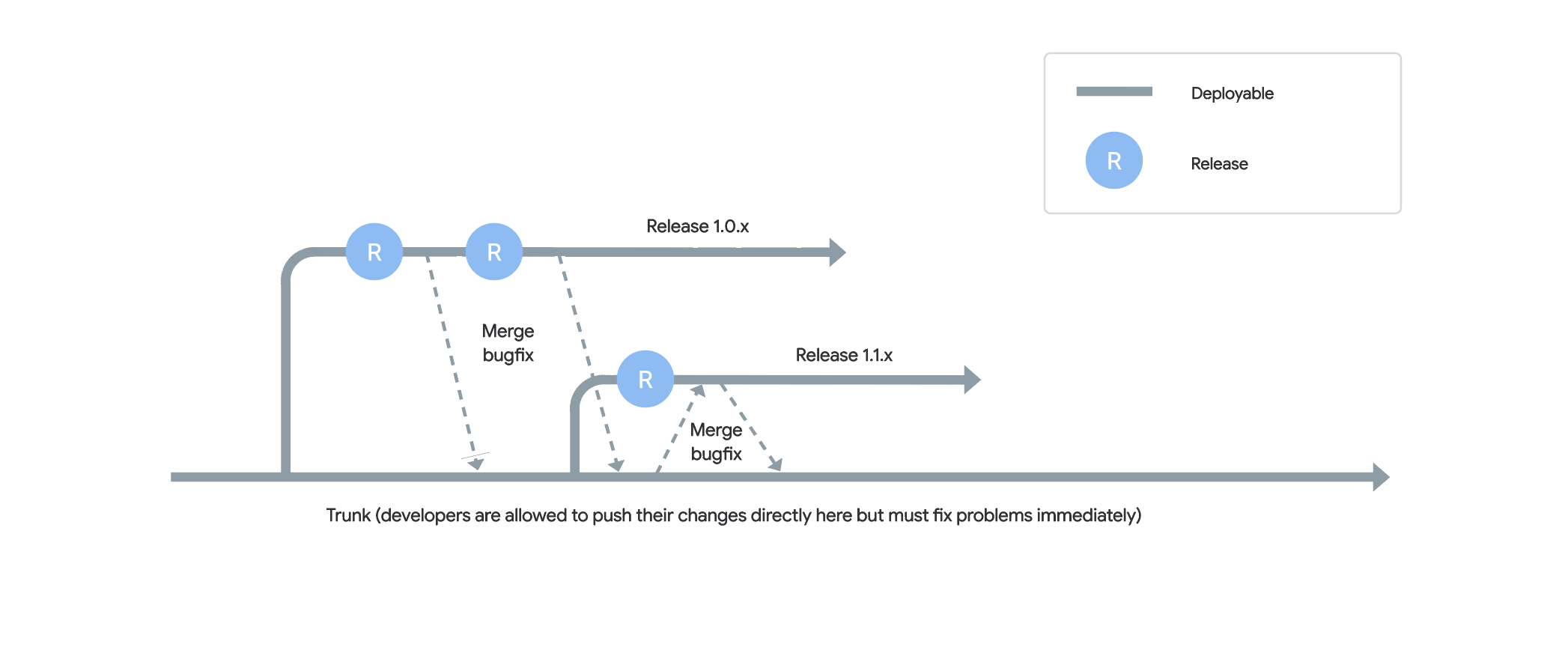 *Image from [Google Cloud](https://cloud.google.com/architecture/devops/devops-tech-trunk-based-development)*
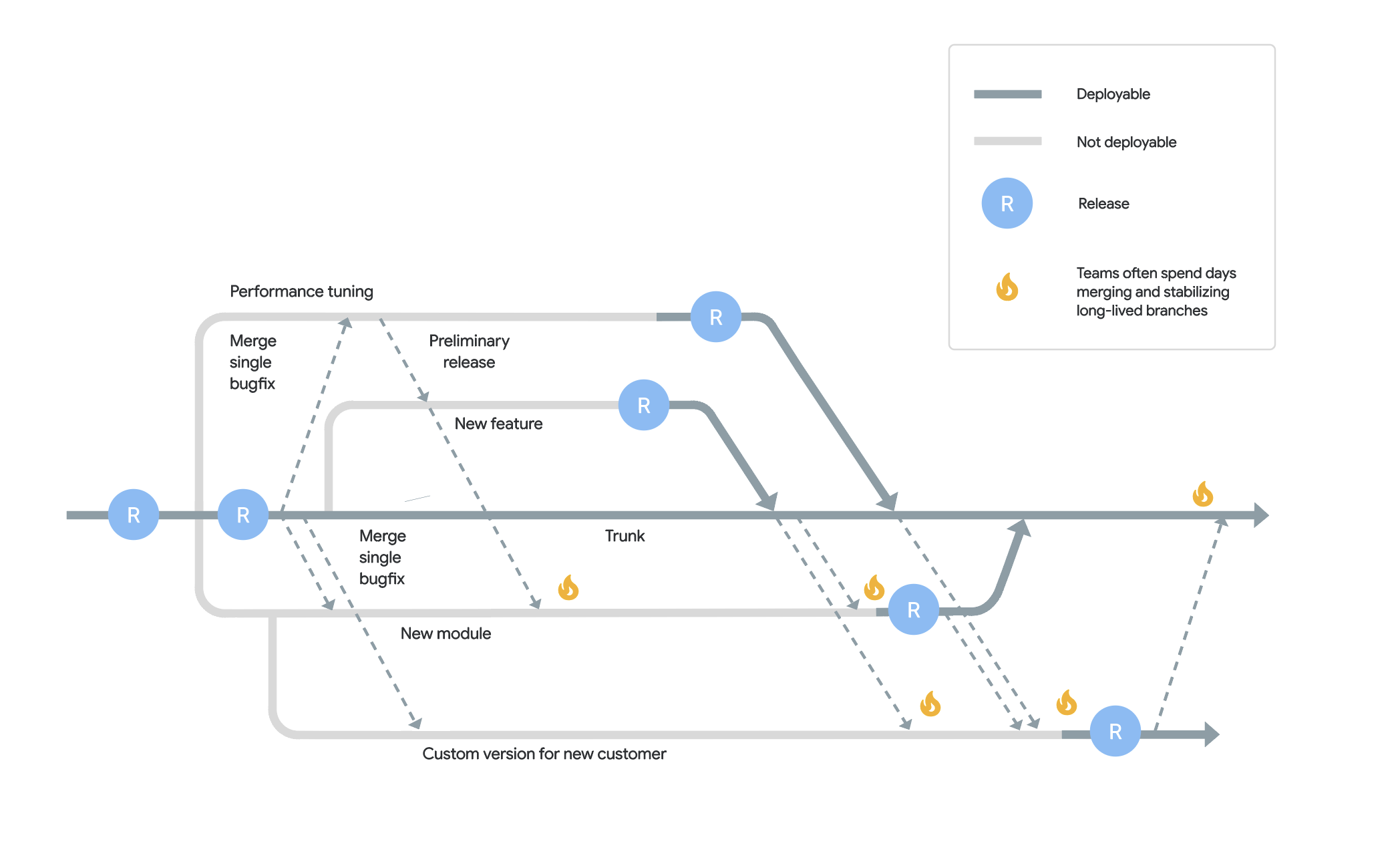 *Image from [Google Cloud](https://cloud.google.com/architecture/devops/devops-tech-trunk-based-development)*
## Benefits of trunk-based development
There are many benefits of trunk-based development, but these are the most notable ones:
* **Fast feature delivery**: In trunk-based development, changes are continuously integrated and tested (the `trunk` must always be green), so new features can be delivered faster than in a feature-branching model where features are developed in isolation and then integrated later.
* **"Green" collaboration:** Team members frequently update and sync their work with the `main` branch in trunk-based development. With this approach, peers integrate each other's changes on an hourly or minute-by-minute basis, ensuring the base they're working off of is never stale.
* **Granular code reviews:** Trunk-based development encourages smaller, "stacked" changes off of `trunk`, making code reviews more manageable and easier to complete. Additionally, since changes are continuously merged and tested, review feedback cycles tend to be much shorter.
## Getting started with trunk-based development
### Small, batched, or stacked changes
First and foremost, developers must understand how to break their changes up into small, dependent branches—those coming from a feature-branch oriented workflow may find this difficult at first.
### Speedy, frequent code review
The goal of trunk-based development is to merge changes as quickly as possible, while still keeping `trunk` error-free. For this to happen, batched/stacked changes should be reviewed as quickly as possible, so branches exist for less than a day. The longer a branch exists, the higher the chance of introducing bugs and merge conflicts when merging the changes into `trunk`. Breaking up changes into smaller, dependent branches allows developers to have their code reviewed and merged while simultaneously working on new changes.
### Limit the number of active branches and feature flags
Many teams have three or more active branches on a given repository—such as a develop branch, a release branch, several feature branches, and a `main` branch. In trunk-based development, it's **strongly recommended** to keep the number of active branches to a minimum.
Since a team's agility depends on the working status of the `trunk` branch, having multiple open branches makes repairing or reverting bad changes to `trunk` unnecessarily complicated. In situations where developers are inclined to create a feature or release branch as a gate or to develop risky features separately from the `main` branch, using **feature flags** is suggested. Feature flags wrap specific changes in an "inactive" code path and can be conditionally enabled/disabled—eliminating the need for creating another branch and instead introducing the changes directly into `trunk` in a non-destructive way.
### Fast automated test suite and build process
To achieve CI, each commit to a repository must undergo testing before, during, and after it merges into `trunk`, and subsequently trigger an automated build process. As a result, this automated test suite should consist of only short-running integration or unit or acceptance tests, and the automated build process should be quick and repeatable. Automated tests should be reliable (not flaky), and should assess the high-level functionality of the code system—and more comprehensive end-to-end tests can be run later on in development.
## See also
* [Trunk-based development overview](https://trunkbaseddevelopment.com/#)
* [Short-lived feature branches](https://trunkbaseddevelopment.com/short-lived-feature-branches/)
* [Trunk-based development: deciding factors](https://trunkbaseddevelopment.com/deciding-factors/)
* [Google Cloud Architecture DevOps tech: Trunk-based development](https://cloud.google.com/architecture/devops/devops-tech-trunk-based-development)
* [Google Cloud Architecture DevOps tech: Continuous integration](https://cloud.google.com/architecture/devops/devops-tech-continuous-integration)
* [Atlassian: Trunk Based Development](https://www.atlassian.com/continuous-delivery/continuous-integration/trunk-based-development)
*Image from [Google Cloud](https://cloud.google.com/architecture/devops/devops-tech-trunk-based-development)*
## Benefits of trunk-based development
There are many benefits of trunk-based development, but these are the most notable ones:
* **Fast feature delivery**: In trunk-based development, changes are continuously integrated and tested (the `trunk` must always be green), so new features can be delivered faster than in a feature-branching model where features are developed in isolation and then integrated later.
* **"Green" collaboration:** Team members frequently update and sync their work with the `main` branch in trunk-based development. With this approach, peers integrate each other's changes on an hourly or minute-by-minute basis, ensuring the base they're working off of is never stale.
* **Granular code reviews:** Trunk-based development encourages smaller, "stacked" changes off of `trunk`, making code reviews more manageable and easier to complete. Additionally, since changes are continuously merged and tested, review feedback cycles tend to be much shorter.
## Getting started with trunk-based development
### Small, batched, or stacked changes
First and foremost, developers must understand how to break their changes up into small, dependent branches—those coming from a feature-branch oriented workflow may find this difficult at first.
### Speedy, frequent code review
The goal of trunk-based development is to merge changes as quickly as possible, while still keeping `trunk` error-free. For this to happen, batched/stacked changes should be reviewed as quickly as possible, so branches exist for less than a day. The longer a branch exists, the higher the chance of introducing bugs and merge conflicts when merging the changes into `trunk`. Breaking up changes into smaller, dependent branches allows developers to have their code reviewed and merged while simultaneously working on new changes.
### Limit the number of active branches and feature flags
Many teams have three or more active branches on a given repository—such as a develop branch, a release branch, several feature branches, and a `main` branch. In trunk-based development, it's **strongly recommended** to keep the number of active branches to a minimum.
Since a team's agility depends on the working status of the `trunk` branch, having multiple open branches makes repairing or reverting bad changes to `trunk` unnecessarily complicated. In situations where developers are inclined to create a feature or release branch as a gate or to develop risky features separately from the `main` branch, using **feature flags** is suggested. Feature flags wrap specific changes in an "inactive" code path and can be conditionally enabled/disabled—eliminating the need for creating another branch and instead introducing the changes directly into `trunk` in a non-destructive way.
### Fast automated test suite and build process
To achieve CI, each commit to a repository must undergo testing before, during, and after it merges into `trunk`, and subsequently trigger an automated build process. As a result, this automated test suite should consist of only short-running integration or unit or acceptance tests, and the automated build process should be quick and repeatable. Automated tests should be reliable (not flaky), and should assess the high-level functionality of the code system—and more comprehensive end-to-end tests can be run later on in development.
## See also
* [Trunk-based development overview](https://trunkbaseddevelopment.com/#)
* [Short-lived feature branches](https://trunkbaseddevelopment.com/short-lived-feature-branches/)
* [Trunk-based development: deciding factors](https://trunkbaseddevelopment.com/deciding-factors/)
* [Google Cloud Architecture DevOps tech: Trunk-based development](https://cloud.google.com/architecture/devops/devops-tech-trunk-based-development)
* [Google Cloud Architecture DevOps tech: Continuous integration](https://cloud.google.com/architecture/devops/devops-tech-continuous-integration)
* [Atlassian: Trunk Based Development](https://www.atlassian.com/continuous-delivery/continuous-integration/trunk-based-development)